Intro
When did the watchmaking industry stagnate to its current, tired state, and how can we restore it to its deserved glory?
Welcome back to Skeptic Time. This blog is my attempt at uncovering the spark long since lost from the watchmaking industry. While the previous post may read more like a preface, let this be my introduction, my manifesto – my guiding philosophy and the compass for all future essays. Hopefully, this post an those following will present an illustration of just why horology would do well to reflect upon itself and its distinguished past.
On a brief admin note – while my domain name is skeptictime.com, I am in fact English, an so would be doing myself a disservice writing sceptic as skeptic. However, the title of the blog will remain for as long as I remain here.
A Brief History
The concept of timekeeping is one as old as civilisation itself – dating as far back as the Ancient Babylonian and Egyptian empires. For as long as we have walked the Earth, we have sought to record, categorise and share information. This, combined with the innate human ability to sense the passage of time (regardless of arbitrary subdivision like seconds, minutes and hours), is almost certainly a driver for us to begin tracking time: to timestamp records and plans, and study how a situation, data point or society evolves. Early universally agreed timekeepers, such as the solar day, lunar month and solar year, facilitated a degree of organisation required to form and maintain the immensely successful dynasties that made the cradle of civilisation what it was. This useful tool quickly became a fascination, both as a science and an art, and has persisted until the modern day – from sundials dating back to the eras of the Old Testament, to illustrious water-driven astronomical clocks of the Song dynasty, early examples of the revolutionary escapement mechanism ubiquitous in wristwatches today.
A 1271 treatise of English astronomer Robertus Anglicus indicates early attempts at the construction of a timekeeping device purely driven by gravity, and by the 17th century, Christian Huygens – the father of modern timekeeping – had invented the grandfather clock, a device which rapidly spread throughout wealthy households of Europe. The 20th century saw the timepiece’s greatest boom of interest, with houses like Patek Philippe, Audemars Piguet and Rolex travelling from their Swiss manufactures to Manhattan, Monte Carlo and Dubai. Globalisation played a huge role in elevating the industry from a previously select customer pool of aristocrats and royalty to generating a 12-figure (USD) revenue in 2023, attracting buyers from every income bracket.
Despite the currently booming industry, watchmaking has seen a certain decline in artistic expression across this period. Balance sheets drive mass production of uninspired timepieces, and while the democratisation of the wristwatch is undoubtedly a great thing, there is a degree of sadness to be felt when reflecting upon the timepieces of the early 20th century. It seems to me that the trajectory of the industry has seen it suppressed and reduced to a servant of capitalism.
Art, Stifled
As the years advanced, so too have our timekeepers – but not without cost. Today, the industry that once celebrated artisanal design has discarded that in place of profit, leaving little room for the creative spark that once defined it.
There is no way to convey the feelings I hold for the watchmaking industry without coming off as somewhat scathing – and so I will commit to it. There are those in the world of haute horology who believe theirs to be a perfected art (or science) – but I am firm in my belief that such a take is without vision. The fundamental difference between those aforementioned and those who share my views is perspective.
For some, timekeeping is defined by function—with form relegated to an afterthought. In this regard, one can comprehend quite plainly how the industry has stagnated. The quartz watch allowed a degree of precision previously incomprehensible to Huygens and the like. Thus, why would we waste time on a perfected science, when the problem we sought to answer has been solved?
For the vast majority of consumers and professional watchmakers, form takes centre stage. However, the form of the wristwatch available to us is as varied, as unique as the industry deigns to make it. And so, with consumers daring not to break trends dictated by the maisons and ateliers on the top of the pile, our view of what a timepiece should look like is restricted.
My fascination comes from the blend of these two objectives, with a third place sitting alongside them – true and genuine innovation. When is the last time a major luxury watchmaking house released a model that was actually innovative? With features never seen before? With creative, interesting design? I would posit that, aside from extortionately expensive options and a few one-offs from the lower end of the price scale (see the Moonswatch Mission to Earthphase), consumer-facing innovation no longer exists in the industry.
Just take a visit to the Patek Philippe Museum in Geneva, and you will see for yourself just how far we are from the standards of the early- to mid-20th century. Design has become bland, over-simplified and repetitive, and originality has been lost. The watches of this collection, when taken in context of those today, beg the question: when did our industry stagnate to its current, tired state, and how can we restore it to its deserved glory?
The hosts of this thoroughly impressive series themselves are victim to this crisis. The Cubitus, their first new collection for 25 years (yes, 25 years), is just a boxy Nautilus – the dial is identical in all but shape, the bracelet is virtually unchanged, the indices are the same and the crown setting, too.
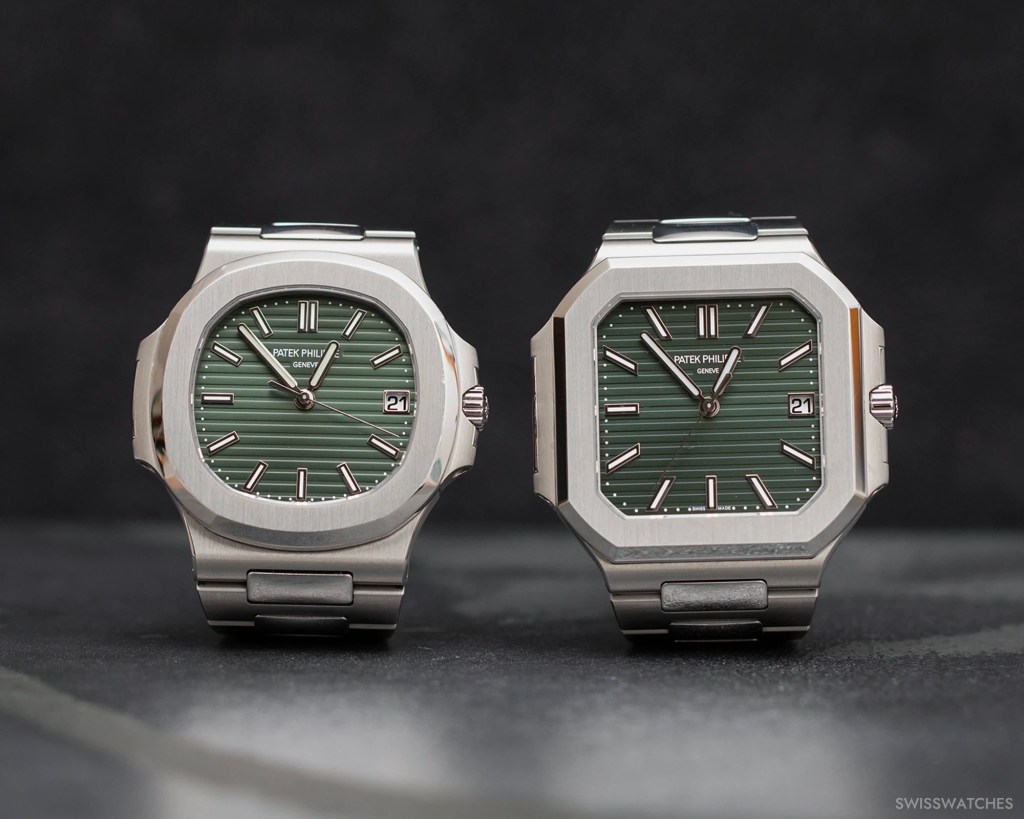
The above is taken from the article “Collector’s View on Patek Philippe’s Cubitus: ‘Am I Seeing Double? I Might Be, But That’s Fine By Me’”. Such a title, of whose kind is not uncommon, perfectly displays the arrogance, snobbery and presumption of the industry and each of its stakeholders today. A house with as rich a history as Patek Philippe ought never be producing such derivative work – two collections so similar from such a brand, with 25 years of development between them, are emblematic of the creative failings we are in the midst of.
It is watered-down new pieces like these that only contribute to the stagnation of the industry that so many of us love. Some (and perhaps, myself) might go as far as to argue that the collection is an insult to the legacy of the great Gérald Genta, the genius bringing us the original Nautilus in 1976, as well as such influential designs as Audemars Piguet’s Royal Oak.
A New (Old) Philosophy
I ought, really, to spend some time defining innovation – as I mean to use it going forward – if I am to brandish it around as I have here. From a higher level, I see it as hope – a hope for fundamental change in an art, science, industry or in truth, any space or craft to which one can apply oneself.
For my purposes, and case study of the wristwatch, further precision in defining innovation is a challenge, however I would like to boil it down to the inspiration of fascination in a non-enthusiast. A watch not conforming to design paradigms of those today – the static face with any number of repetitive and tired complications, often disruptive and antagonistic of design.
A chronograph, for example, or at least, as one comes today, provides a modest amount of function at the expense of complete stylistic interference. Oft-unappealing buttons adorn the case, rendering it into more of a chunky piece of industrial equipment, where form is irrelevant. On the other hand, something like a perpetual calendar, a moon phase or even a simple date window, provides, to me, much more fascinating information. These are able to present in an elegant way naturally, contributing to the beauty of the timepiece.
I come back to the Moonswatch released at the back end of last year, which displayed (as far as I am aware, do correct me if I am wrong) a first-of-its-kind Earthphase complication. For context of readers not aware of the watch, the Earthphase presents the Earth, as seen from the Moon, which showcases phases much like the new, crescent and full Moons. For a (relatively) low entry point, consumers were afforded the opportunity to sport a debuting feature of horology on their wrists, for the first time in what feels like a very long time.
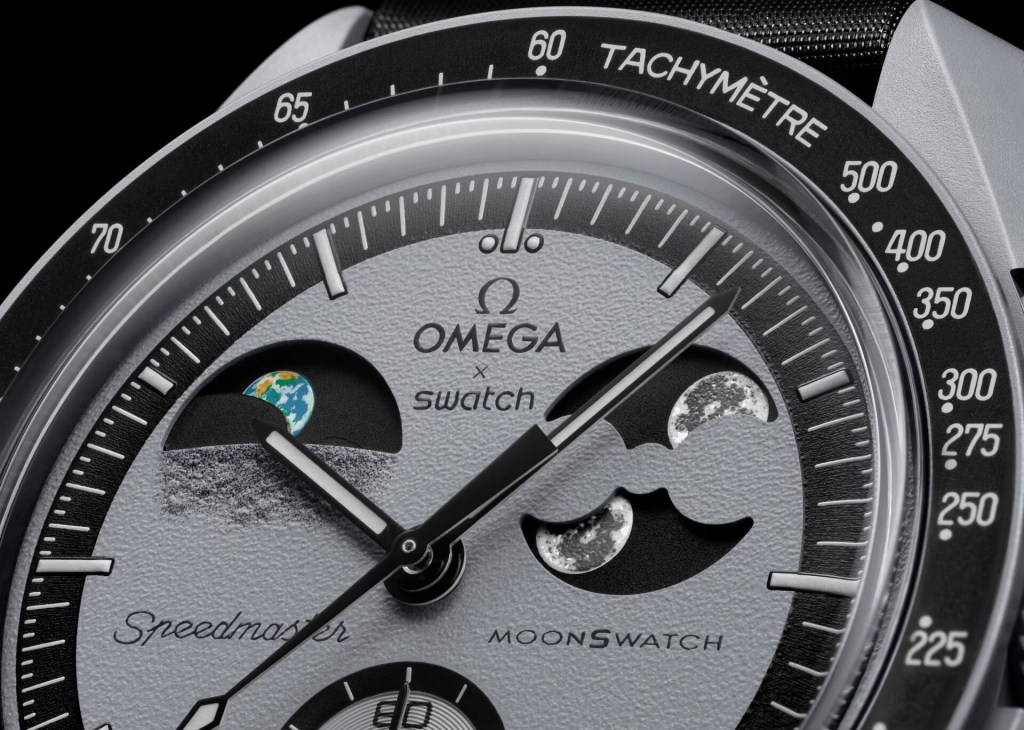
The pop of colour against the grey and black background supplies a wacky yet tastefully selected feature. Admittedly, and perhaps an early failing of this blog, the Earthphase does feature a chronograph, and a somewhat unappealing one at that too. However, I am able to look past it in light of the Earthphase complication’s design excellence.
While perhaps not the most practical of complications, the Earthphase isn’t just a technical novelty – it embodies the kind of creative risk that defies convention and sparks genuine fascination. I am, and I would imagine that my readers are, too, intrigued by the weird and wonderful, by the subversion of the “classic”, and by watches – unlike the Cubitus – that are not clear rip-offs of other, successful lines. This blog’s fascination is afforded to those watchmakers seeking to bring fresh ideas, with exquisite execution, to the forefront of the field – those who drive change.
It is, I might add, not only innovation I seek in a watch, but also craftsmanship of an artisanal quality. Mass production, as a design philosophy and a practical method, utterly obliterates any hope of artisanal work, in the traditional sense of the word. While machinery and precision equipment undoubtedly contributes to the betterment of the field in both cost, availability and quality, it is the total replacement of human input with machine that takes us further from creative progress. Instead of a growing market leading to more and more watchmakers, the number of horologists has shrunk as major names monopolise competition and regularly outsource production to machinery-intensive methods.
Often innovation and the work of an artisan are presented in conjunction – innovation doesn’t need to be explosive, in your face, every detail of the watch never-seen-before. Innovation can be something as simple as the curved date hand on this Blancpain Villeret 6664.
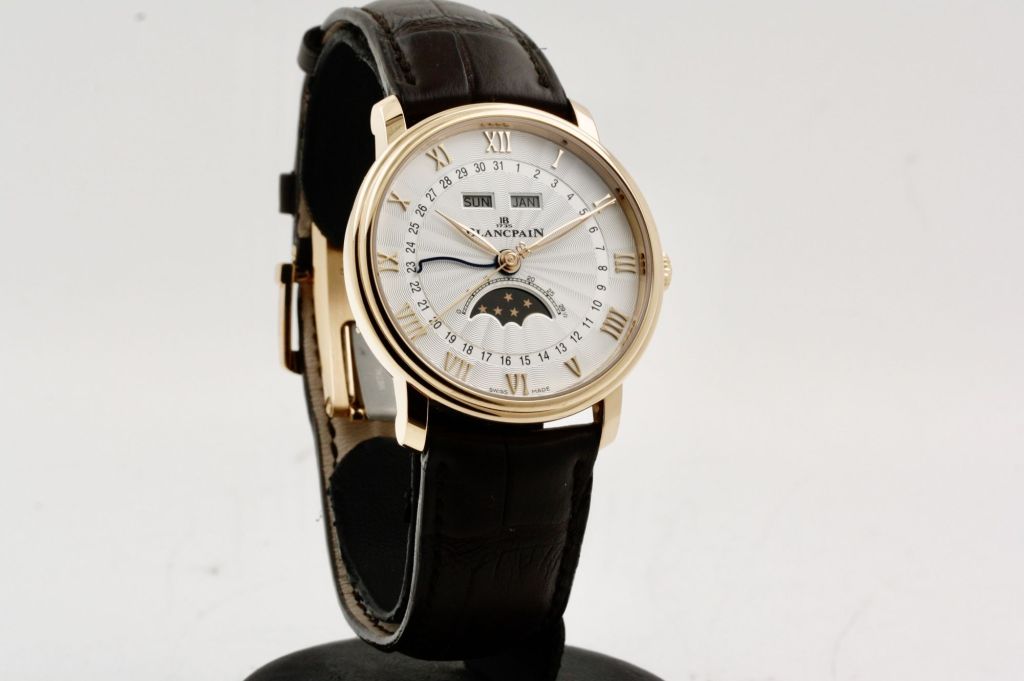
The difference in such a small change to the watch’s composition affects the aesthetic entirely, allowing for a more playful and fun feel that draws the eye – as well as providing something standing out from other straight-handed models (the moon phase and triple calendar help too). While I cannot attest as to whether or not it was the first of its kind, its rarity provides enough intrigue to keep me fascinated.
Closing Words
Of course, there are holes in my philosophy – this is something I do not lament. If I am wrong, then the industry is in a far better place than I have portrayed it here. However, the price of true ingenuity has been on an upward trend for decades, and the average consumer is no longer able to even have sighting, let alone ownership, of such a commodity. There are certainly timepieces out there challenging the modern take on what watchmaking is, and I intend to explore those in coming posts.
Beyond this, it is not every collector or consumer who buys a watch with nothing but brand and value in mind. And for those who do, watches are, after all, very sound investments – if they are taken care of. Their value persists very well, and many harder to find references, dials and features can often be found far exceeding their retail price on secondary markets.
There is an undoubtable level of elegance and beauty to a simple watch, and many occasions suit far better a more toned down timepiece – I myself own a PRX, something close to the very height of simplicity. The issue I have is not with simple watches, but with a clear lack of fascinating ones. The vast majority of simple watches are not fascinating, and worse, the vast majority of modern watches are not simple. My concern is that function has driven the industry to be one of increasingly rare beauty.
I ought to make it clear that this is anything but a declaration of disbelief and disenchantment with horology, but a hope for change within the industry – for true innovation to return, and for the wristwatch to allow better for all kinds of personal expression. Of course there are fiscal, commercial and technological constraints holding us back from where I might believe we ought to be, but I argue that the root cause is a systemic and collectively psychological one – an aversion that I believe breaking through will elevate the watchmaking industry to the heights that it is worth.
Stay tuned for the following post, a part two, if you like, to this one – exploring the Patek Philippe Museum, in Geneva, a place inspiring me to put my misgivings to paper (digitally) and ultimately take on this endeavour. In the meantime, you can find me posting less and less infrequently at @atelier.du.lino on Instagram. In coming months, I will explore watches showcasing what I am truly seeking in a watch – as well as talking on topics far and wide, some less adjacent to horology than others, but, I hope, all with a common thread. The situation as I present it is not unique to watchmaking, and more and more creative disciplines come under financial scrutiny, more often than not leading to a suppression of voice and genuine self-expression.
I appreciate that my thoughts may provoke firm disagreement, however it is critique and the ensuing debate that open a field to progress, and I hope that these essays can facilitate this. I acknowledge, in advance, that I write with grumpiness and scepticism, something that an interested reader should prepare for, however like I said – I am committing to this. After all, a blog named Skeptic Time is nothing if not sceptic.
 Skeptic Time
Leave a comment